What Matters in AI Agents
The future of AI agents won’t be decided by abstractions, but by outcomes.This post is a call to focus on what really matters. Here’s what the real conversation should be about.
 João (Joe) Moura

The Noise
The AI agent space is moving fast. New frameworks. New Products. New paradigms. New philosophies.
And with that, naturally, comes noise.
Over the past few months, we’ve seen an explosion of blog posts, side-by-side comparisons, and hot takes on what constitutes a “real” agent framework. Declarative vs imperative. Graphs vs loops. Abstractions vs control.
Some of it is thoughtful. A lot of it is performative. All of it is biased—including us.
But here’s the thing: while the internet debates syntax trees and orchestration models, builders are trying to ship. Developers are wiring up tools. Builders are moving prototypes into production.
Teams are asking: can we trust this system when it counts? That’s the conversation we care about.
Not which framework wins the next tweet war—but which one actually helps users get things done.
The Truth
Users don’t care about frameworks. They care about what the system does for them.
Whether you’re an indie hacker wiring up a weekend side project or an enterprise architect rolling out AI across business units—value is the goal.
Not feature checklists. Not abstraction purity. Not whether something is a “workflow” or an “agent.”
Just:
Does it solve the problem?
Can I trust it to run?
Can I build on it without friction?
Every person is empowered to do even more, in logistics for example [thanks to CrewAI Enterprise] we can implement a carrier in 10 minutes, that used to taken 5 days [...] We are very excited about where this agentic future will take us. [Gelato Case Study] StevenVice President of Product at Gelato
It’s easy to get caught up in internals.But from the user’s perspective, those are implementation details.In the end, value wins. Every time.
The Trap
In fast-moving ecosystems, it’s tempting to zoom in on features—stacking them side by side like that solves anything.
But focusing too much on surface-level capabilities can lead you into a trap: mistaking surface complexity for real capability.
Good engineering hasn’t changed. We still ask:
What’s the simplest version of this that works?
Where’s the single source of truth?
How do I make this maintainable and auditable?
What’s the minimum I can get away with?
Principles like KISS, composition over inheritance, SOLID—these apply just as much to agents as they ever did to web apps and APIs.
The point isn’t to build more complex agents. The point is to build better systems—reliable, composable, observable, and sane to debug.
So when we see frameworks framed purely through their internals—imperative vs declarative, graph vs loop, abstraction vs orchestration—The difference is this:
You’re talking about tools. We’re thinking about systems.
The Opportunity
The beauty of this moment is that we’re still early. The patterns are still forming. The best practices are still being written. And that means there’s room for experimentation—and for divergence.
We’ve said it before: there’s no one right way to build agentic systems.
Some teams will benefit from highly structured flows. Others will lean into autonomous agents. Most will use both—intertwined, dynamically composed, driving value together. (we call it CrewAI Flows)
That’s not a problem. That’s progress. This space doesn’t need more dogma. It needs frameworks that give users options—without forcing them to pick sides. It needs ecosystems that interoperate, tools that compose, and systems that meet teams where they are.
More flexibility. More control. Less ideology. More value.
In the past we have used RPA to do certain tasks, now we want to leverage the CrewAI Agents to complete those tasks [...]We have seen the evolution of the product getting mature over the last year[...] [IBM Case Study] Narayanan AlavandarDistinguished Engineer & Chief Architectat IBM Consulting
The Real Work
The hard part of building AI agents isn’t choosing between a graph or a loop. It’s not whether your orchestration syntax is declarative enough.
The hard part is everything that happens around the LLM:
Making sure it has the right context at the right step.
Handling failures, timeouts, and edge cases gracefully.
Adding observability so you can debug, audit, and improve.
Building guardrails that keep things safe.
Supporting human-in-the-loop workflows when real-world stakes demand it.
Ensuring your system is interoperable with the rest of your stack.
Giving teams the governance and visibility they need to move fast without losing control.
These are the things that matter when you go beyond prototypes. This is what separates “it worked in a demo” from “this runs in production.”
This is where, in my biased opinion, CrewAI and its enterprise suite shows up—not with theory, but with tools designed to handle the complexity, so you can focus on outcomes.
We went from roughly 10% accuracy on code generation to 70%+ once we brought CrewAI agents into the workflow. [PwC Case Study] Jacob WilsonCommercial GenAI CTO at PwC
The CrewAI Way
At CrewAI, we didn’t set out to win framework debates.
We set out to build the platform we wanted to use—one that could scale from weekend projects to mission-critical systems.
That’s why we built a system that blends multi-agent collaboration (crews) with event-driven orchestration (flows), and why we build an entire stack around it on our CrewAI Enterprise products. Where agents and flows aren’t mutually exclusive—but work together, cleanly and composable. Where you can start simple, grow complex, and never feel boxed in by your own tooling.
We believe abstractions are powerful—when they stay out of your way.
This isn’t about minimal demos or flashy benchmarks. It’s about building systems that last.
We’re still in the early days of AI agents.
The ideas are still evolving. The tools are maturing. The standards aren’t sticking yet. That’s a gift—because it means we have the chance to get it right.
Not by arguing over abstractions. Not by fighting to be the most “correct.” But by building systems that work. By helping each other ship better, faster, safer.
We’re proud of what we’ve built at CrewAI.
Proud of our users—open-source contributors, indie builders, and enterprise teams alike—who are showing what’s possible with agents in production. And we’re just getting started.
So to everyone building in this space:
Keep going. Keep shipping. Stay focused on value. The real work isn’t behind us—it’s ahead
Related News
 Crew AI Enterprise
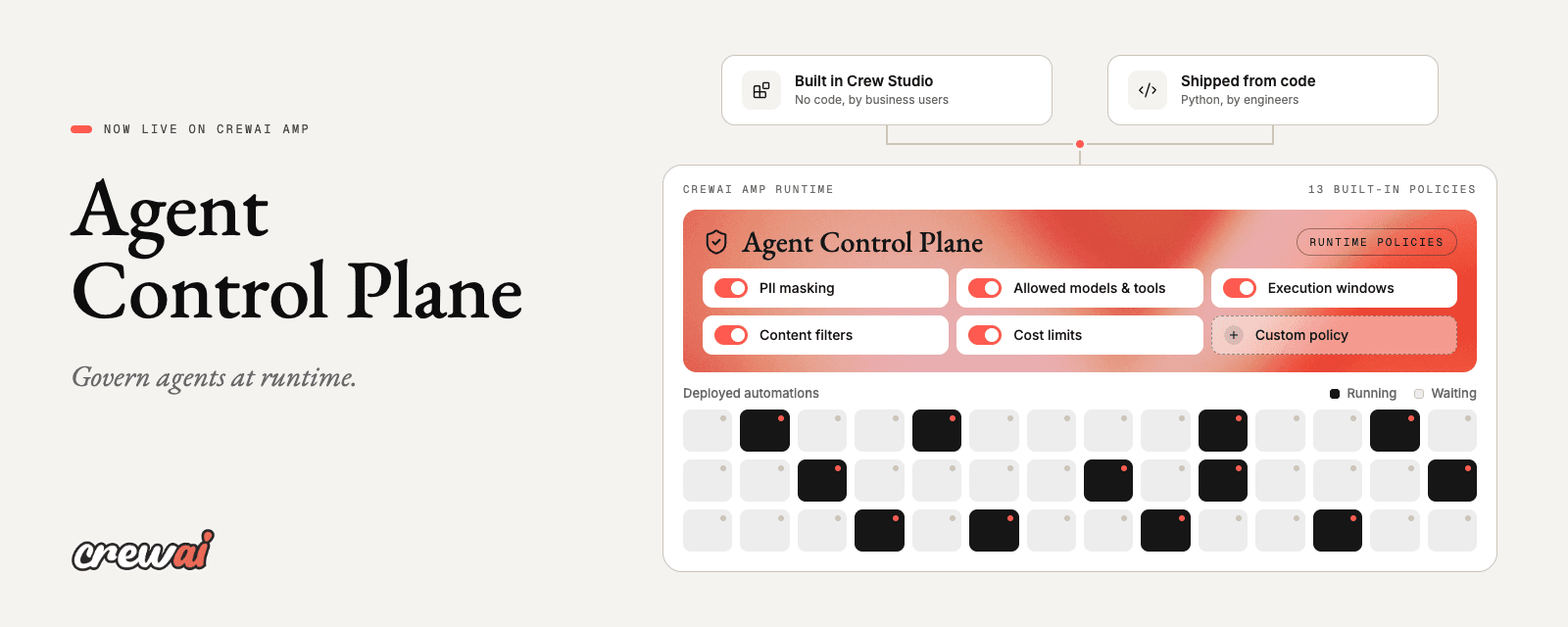
How to govern enterprise agents at runtime with the CrewAI Agent Control Plane
João (Joe) Moura | October 16, 2026
 Crew AI Enterprise
The People Who Understand Don't Build. The People Who Build Don't Understand.
Pedro Moura | August 14, 2026
 Crew AI Enterprise
Crew Studio: The Automated Agent Builder
Jesse Miller | July 28, 2026


